
-

Prorope
Kinetisk bogserlina - 32 mm i diameter - Brottstyrka 20 000 kg
Ordinarie prisFrån €94,50Enhetspris

Prorope.com
Prorope HMPE Winchförlängningslina med rostfria öglesplitsar
Ordinarie prisFrån €73,95Enhetspris-
-
-

Prorope
Certifierad D-ringsschackel 8,5 ton med bröstbult 28 mm tjock.
Ordinarie pris €25,50Enhetspris
Prorope
Certifierad D-ringsschackel 9,5 ton med bröstbult 32 mm tjock.
Ordinarie pris €35,00EnhetsprisMycket lågt lager (5)
Prorope
D-ringsschackel SWL 12 ton. Stifttjocklek 35 mm
Ordinarie pris €49,75EnhetsprisMycket lågt lager (2)
Prorope
Certifierad D-ringsschackel 2 ton med bröstbult 16 mm. Suzuki Jimny
Ordinarie pris €6,50Enhetspris
Prorope
Kinetisk bogserlina - 40 mm i diameter - Brottstyrka 40 000 kg
Ordinarie prisFrån €165,00EnhetsprisMycket lågt lager (2)
Prorope
Kinetisk bogserlina - 28 mm i diameter - Brottstyrka 14 000 kg
Ordinarie prisFrån €82,50EnhetsprisMycket lågt lager (2)Prorope
Kinetiskt bogserlina - 56 mm i diameter - Brottstyrka 65 000 kg
Ordinarie prisFrån €249,95EnhetsprisMycket lågt lager (4)-

Prorope
Kinetiskt bogserlina - 48 mm i diameter - Brottstyrka 50 000 kg
Ordinarie prisFrån €149,00Enhetspris
Prorope
Kinetisk bogserlina - 24 mm i diameter - Brottstyrka 10 600 kg
Ordinarie prisFrån €64,75EnhetsprisMycket lågt lager (1)


4x4 recovery means getting your vehicle free when it is stuck: with a second vehicle and a kinetic recovery rope, or with a winch. Below you choose the right diameter by weight.
- 2–3×
- the weight of the lighter vehicle: that is how strong a kinetic recovery rope should be
- 1,770 kg
- measured breaking strength of our 10 mm kinetic recovery rope (average)
- 10–56 mm
- kinetic recovery ropes, made to length by us
- 13:00
- order before 13:00 on a working day (in stock) and we ship the same day
Which tow rope for your 4x4? The 4x4 recovery size chart
Choose a kinetic recovery rope with a breaking strength of 2 to 3 times the maximum permissible mass of the lighter vehicle. You will find that weight on the registration document. If the lighter vehicle is registered at 2,600 kg, choose 18 mm.
| Weight of lighter vehicle | Kinetic recovery rope | Breaking strength | Price | View |
|---|---|---|---|---|
| up to 850 kg | 10 mm | 1,780 kgmeasured: avg. 1,770 kg | from €24 | View 10 mm |
| 850–1,250 kg | 12 mm | 2,565 kg | from €26 | View 12 mm |
| 1,250–1,750 kg | 14 mm | 3,500 kg | from €30 | View 14 mm |
| 1,750–2,250 kg | 16 mm | 4,500 kg | from €38 | View 16 mm |
| 2,250–3,000 kg | 18 mm | 6,000 kg | from €45 | View 18 mm |
| 3,000–3,500 kg | 20 mm | 7,400 kg | from €39,50 | View 20 mm |
| 3,500–4,000 kg | 22 mm | 8,300 kg | from €44,95 | View 22 mm |
| 4,000–5,300 kg | 24 mm | 10,600 kg | from €64,75 | View 24 mm |
| 5,300–7,000 kg | 28 mm | 14,000 kg | from €82,50 | View 28 mm |
Breaking strength is not a working load. The maximum permissible mass on the registration document is the weight fully loaded. Heavier than 7,000 kg? We make kinetic recovery ropes up to 56 mm and 65,000 kg: see all kinetic recovery ropes.
Why not simply go thicker?
A kinetic recovery rope has to stretch. If it is too strong for the vehicle, it stretches too little and the shock goes into the recovery points. Only with a winch rope or tow strap do you go stronger when in doubt.
Why lower per mm than nylon?
Our kinetic recovery ropes are made of composite: polyester with polypropylene. Many other kinetic ropes are nylon and have a higher breaking strength at the same diameter. So compare by breaking strength, not by diameter: the chart above shows which breaking strength suits your vehicle.
Connect with a soft shackle or bow shackle that is at least as strong as your rope. Note: a soft shackle shows its breaking strength, a bow shackle its working load limit (WLL). When pulling from two recovery points, a bridle spreads the load.
4x4 recovery with a winch: the right winch rope
We recommend a breaking strength of at least 2 times the pulling force of your winch. That pulling force applies to the first layer on the drum. A 4,300 kg (9,500 lb) winch therefore needs at least 8,600 kg breaking strength. Always follow your winch's instructions.
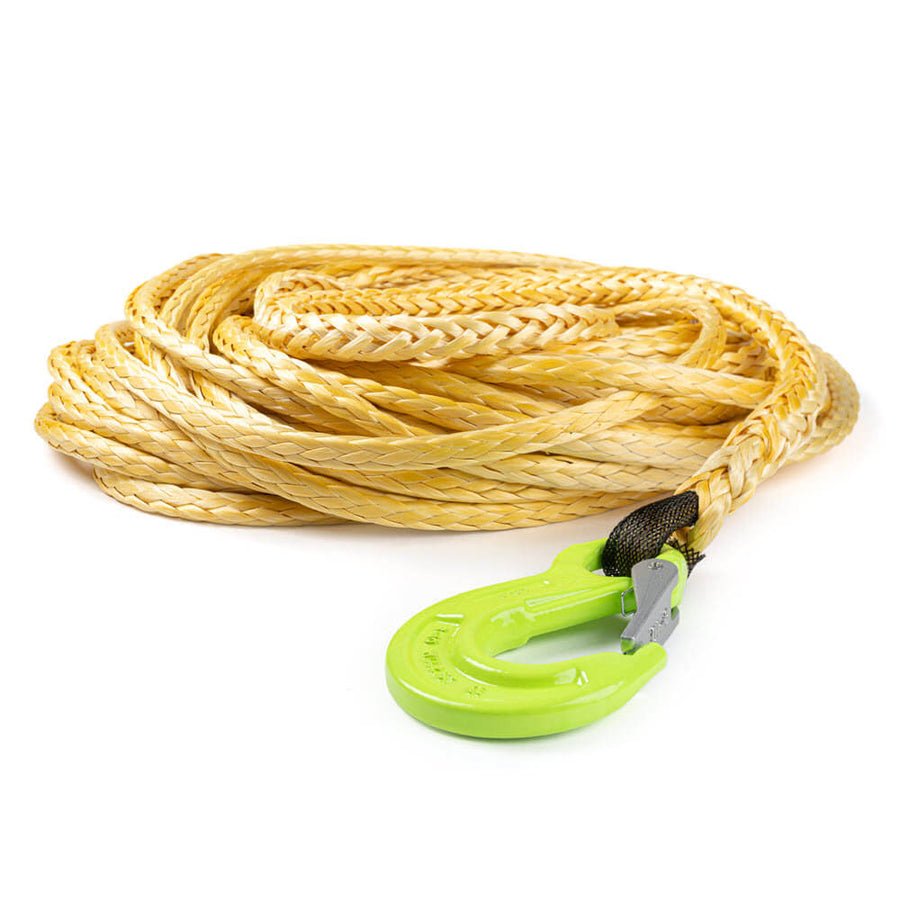
Dyneema SK75 winch rope with hook
- Yellow, braided from Dyneema SK75 fibre
- 6 to 16 mm, 10 to 40 metres
- Safety hook spliced in by us
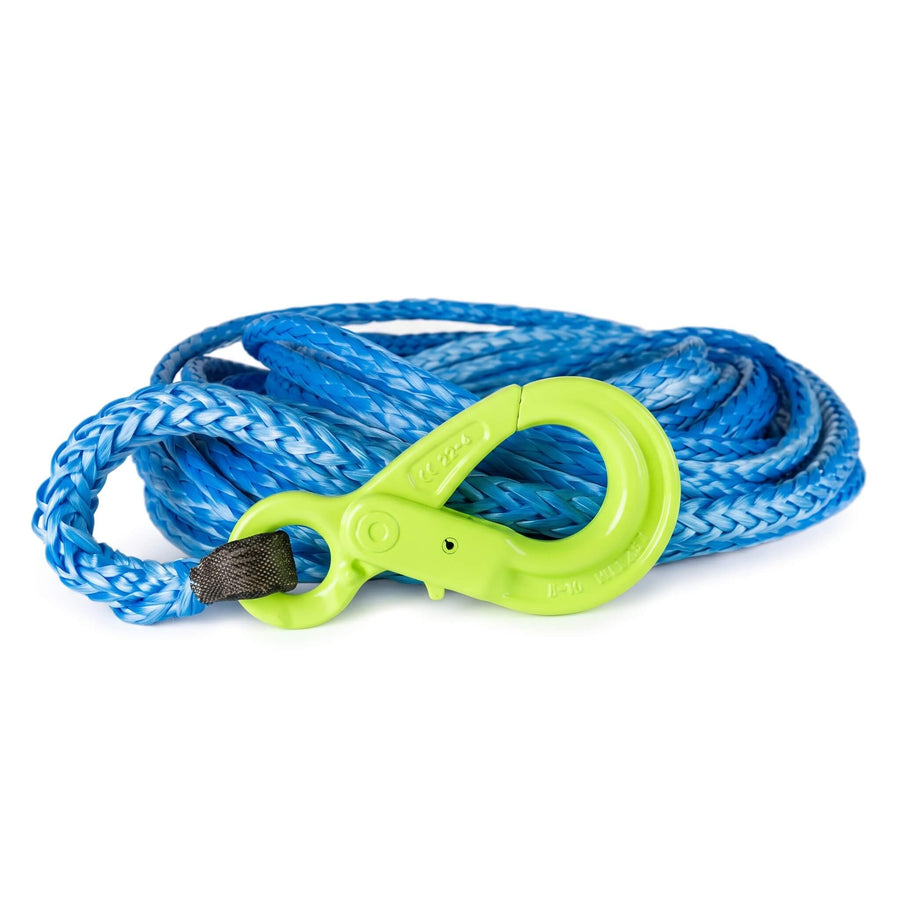
Prorope HMPE winch rope with hook
- Blue, 12-strand braided with coating
- 6 to 16 mm, 10 to 40 metres
- Safety hook spliced in, with protective sleeve
- Hawse fairlead, not a roller fairleadSynthetic winch rope belongs on a smooth aluminium hawse fairlead. Switching from steel? Replace the fairlead as well.
- Too short?Extend with a winch extension line with stainless steel eyes, and never wrap the rope around a tree: use a tree trunk protector.
4x4 recovery: never do this
Each rule tells you what to use instead.
- Never use a tow ball or tie-down point
They can break off and fly. Use a proper recovery point with a soft shackle or bow shackle.
- No bystanders nearby
Keep everyone at least 1.5 times the rope length away. A recovery damper or heavy blanket halfway along the rope reduces recoil if it breaks, but does not rule it out.
- No snatch with a tow strap
A static tow strap barely stretches. Recovering with a run-up is done with a kinetic recovery rope from the size chart.
- No steel shackle between two ropes
Join two kinetic recovery ropes loop through loop or with a soft shackle. Steel becomes a projectile if something breaks.
- Not for towing on the road
Kinetic ropes are made for recovery, not for towing on public roads. Road towing rules differ per country: see the questions below.
- Never lift
Winch ropes, recovery ropes and soft shackles are recovery equipment, not lifting gear.
4x4 recovery gear we test ourselves
Otto Tromm pulls rope to breaking point on our own tensile testing bench, following ISO 2307:2019 as closely as possible. For each test we do several pulls and publish the average and the lowest measurement.
| Rope | Average | Lowest | Test |
|---|---|---|---|
| Kinetic recovery rope 10 mm | 1,770 kg 17.37 kN | 1,622 kg 15.91 kN | 26-1-2026PR-2026-CMP-0100-GK-001 |
| Prorope HMPE rope 4 mm | 1,827 kg 17.93 kN | 1,782 kg 17.48 kN | 17-3-2026PR-2026-HMPE-0040-GK-003 |
Breaking strength is not a working load: always allow a generous margin. All results are in the rope test database, and here you can read how we test.
Questions about 4x4 recovery
What should I buy first if I don't have a winch?
A kinetic recovery rope that suits the weight of your vehicle (see the size chart), two soft shackles and a recovery damper or heavy blanket to lay over the rope.
Kinetic recovery rope or tow strap?
Stuck in mud or sand? Use a kinetic recovery rope: it stretches and pulls the vehicle free with a gradual jerk. A tow strap barely stretches and is for steady towing of a vehicle that is already rolling.
Can I use this for towing on the road?
Kinetic ropes are made for recovery, not for towing on the road. Road towing rules differ per country, so check your local rules. In the Netherlands, for example, the gap between vehicles may be no more than 5 metres. In Belgium towing is only allowed if the vehicle can no longer move under its own power: at most 25 km/h, not on the motorway, and above 3 metres the connection must be marked.
Can you make a rope to measure?
Yes. We make our kinetic recovery ropes and winch ropes to length ourselves. A winch rope gets one spliced-in hook; a hook on both ends is not possible. For clubs and business orders, request a quote.
4x4 recovery made to measure or help choosing?
A different length, a club set or unsure about the right diameter? Otto will help you choose. Call +31 77 208 6139 or email info@prorope.com.
Ordered before 13:00 on a working day and in stock? Then we ship it the same day.
Last checked: October 2026