
-

-

-
-

Liros
Liros XTR Racer – Racing Sheet | Dyneema SK78 Core | Aramid/Polyester Sheath
Regular priceFrom €9,95Unit priceIn stock (308 units)-
Prorope.com
Prorope HMPE Winch Extension Line with Stainless Steel Eyes
Regular priceFrom €73,95Unit price-
Prorope
UHMWPE rope with polyester sheath - 3 mm diameter
Regular priceFrom €29,95Unit priceIn stock (40 units)-


Our range
Types of Dyneema rope at Prorope
 SK75
SK75Original DSM/Avient Dyneema fibres with the highest abrasion resistance in our range. Stronger and lighter than steel. The choice for intensive use.
View SK75 rope T70
T70The same breaking strength as SK75, but softer and more supple in construction. Easy to splice and pleasant in the hand.
View T70 Hawkline HMPE
HMPETechnically almost identical to SK75: extremely high breaking strength, minimal elongation and low weight. Standard blue, on request in virtually any colour.
View HMPE ropeMeasured breaking strengths — our own test bench (avg. of 5 tensile tests, no knot · ISO 2307:2019, measured by Otto Tromm)
| Rope | Diameter | Construction | Breaking strength | ≈ kg |
|---|---|---|---|---|
| Prorope HMPE | 4 mm | 12-strand braided | 17,926 N | 1,827 kg |
| HMPE white + PES sheath | 5 mm | Core-sheath | 10,166 N | 1,036 kg |
| HMPE blue/gold | 5 mm | Braided | 9,266 N | 945 kg |
| HMPE + PES sheath | 4 mm | Core-sheath | 6,698 N | 683 kg |
| HMPE + black sheath | 3 mm | Core-sheath | 4,188 N | 427 kg |
| Dyneema SK78 cord | 1.5 mm | Braided, without core | 2,512 N | 256 kg |
Note: the 5 mm kernmantel tests higher thanks to extra sheath fibres, but carries the kernmantel risk. Construction and finishing determine the end result at least as much as the fibre itself.
Our own test-bench data 2026
What Dyneema rope really does under load
Measured by Otto Tromm — 5 tensile tests per rope, Prorope test method (ISO 2307:2019). We publish the deviations too, not just the pretty numbers.
In the knot bend the outer fibres are loaded more heavily. A splice retains virtually the full strength — a knot loses almost half.
3 mm HMPE: 4,188 N → 1,880 N with knot (−55%)5 mm HMPE: 9,266 N → 4,834 N with knot (−48%)
By first putting the rope under tension the fibres align. Always pre-tension a new winch line without maximum load.
5 mm HMPE: 9,266 N un-tensioned → 10,642 N after pre-tensioning (+15%)In 5 of 5 tests the sheath remained visually intact while the core had broken completely. A kernmantel rope can be broken internally with no visible damage.
Advice: choose a 12-strand braided construction for critical applicationsOur 1.5 mm SK78 gave a cracking sound just before complete failure — in practice a warning signal.
1.5 mm SK78 measured at 2,512 N — exceptionally strong for this thin cordCounter-intuitively: our 1.5 mm with coating scored almost equal to the variant without. Choose coating for abrasion or grip — not for strength.
1.5 mm without coating: 2,512 N — with coating: 2,444 NComparison
Dyneema rope vs steel wire
| Property | Dyneema rope | Steel cable |
|---|---|---|
| Weight | Up to 85% lighter | Heavy |
| Breaking strength | Equal or higher (by weight) | High |
| Buoyancy | Floats | Sinks |
| Snapback on break | Minimal — safer | Dangerous |
| Corrosion resistant | 100% — will not rust | Rusts |
| Handling | Flexible, no splinters | Stiff, risk of wire breakage |
| Elongation at break | < 4% | 1–2% |
Conclusion: choose Dyneema rope when you need steel-wire strength without the weight, the corrosion and the safety risk — on winches, offshore and in lifting work.
Applications
Where Dyneema makes the difference
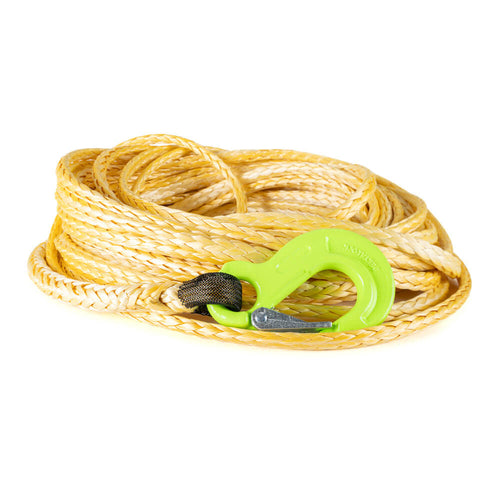
- Winch lines with hook (SK75, 6–16 mm)
- Recovery lines and soft shackles
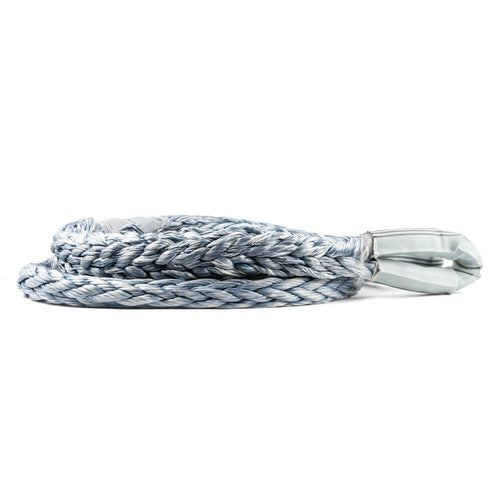
- Tow lines (up to 28 mm, hundreds of tonnes breaking strength)
- Salvage systems
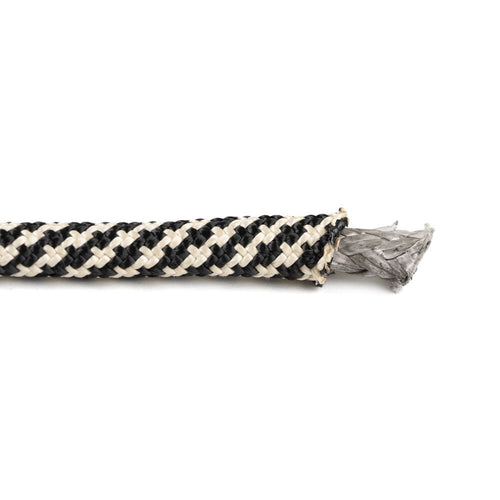
- Halyards, sheets and trim lines
- Racing lines (Liros XTR Racer)
- Hawklines (T70 Hawkline)
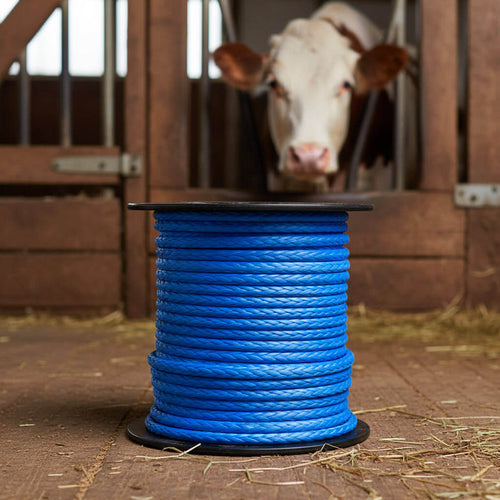
- Lifting lines, tackles and safety lines
- Steel-wire replacement on cranes and winches
- Truck and agricultural tow lines
- Livestock and machine ropes, manure scraper rope
Technical information
Specifications, points of attention & available diameters
Technical specifications
| Material | UHMWPE (Ultra High Molecular Weight Polyethylene) |
| Specific gravity | 0.98 g/cm³ — floats |
| Elongation at break | 3–4 % |
| Melting point | 144–152 °C |
| Operating temperature | Softens from approx. 125–130 °C |
| Water absorption | Virtually none |
| UV resistance | Very high |
| Chemical resistance | Excellent (salt, acids, oil) |
Points of attention when using
- 1 Pre-tensioning: tension the rope first without maximum load. Our own tensile-test data shows up to +15% extra breaking strength after pre-tensioning.
- 2 Bend radius: avoid sharp bends — maintain a bend radius of at least 5–10× the rope diameter.
- 3 Temperature: prevent local overheating from friction. From 125–130 °C the material softens.
- 4 Termination: always finish Dyneema with a splice. A knot can cost up to 55% of the breaking strength.
Available diameters
Available per metre. The 28 mm is a towing cable for offshore / heavy pulling applications.
Buy Dyneema rope at Prorope
Direct from our own stock
Prorope supplies Dyneema and HMPE directly from our own stock. Available by the metre — order exactly what you need, with no minimum order.
Supplying consumers, water-sports users, the offshore industry and agriculture.
Need advice or a quote?
Our rope specialists are happy to help you choose the right diameter, variant or finish.
+31-77 208 6139 · info@prorope.com
Frequently asked questions