📦 Fast EU Shipping
💡 Expert Advice
📞 Personal Support
Wide Range of Stock
🛡️ Premium Quality

Jute Rope

(2 products)

Jute rope is a biodegradable natural rope made from the fibres of the jute plant (Corchorus), grown in warm, humid regions like India, Bangladesh and China. After cotton, jute is the most widely used plant-based fibre in the world. The result is a flexible, lightweight and affordable rope with a warm, earthy look — perfect for gardening, decoration, macramé and crafting, and fully biodegradable after use.

Check out our full collection of jute rope below, starting from €0.35 per metre and available straight from stock. Scroll down for technical specs, applications and frequently asked questions.

View as

Natural & sustainable

Jute rope

Jute is a 100% plant-based fibre: fully biodegradable, coarse in texture and recognisable by its natural golden-brown colour. Prorope supplies jute rope in both braided and twisted constructions, for decoration, gardening, packaging and craft work.

103 kgBreaking strength twisted Ø 4 mm (measured)
125 kgBreaking strength braided Ø 6 mm (measured)
100%Biodegradable
Jute ropeAll breaking strengths measured in our own test lab in accordance with ISO 2307:2019 by technical director Otto Tromm.

Why choose jute rope?

Fully naturalJute is a plant-based fibre that is compostable and biodegradable — ideal for environmentally conscious applications.
Warm appearanceThe characteristic golden-brown colour and coarse texture give jute rope an authentic, artisanal look.
Excellent gripThe coarse fibre structure provides excellent grip, even when wet in the garden.
LightweightJute rope is relatively light, which makes it comfortable during long jobs and pleasant for decorative work.
AffordableJute is one of the most affordable natural fibres, suitable for both small projects and larger applications.
Wide rangeProrope supplies jute rope both braided and twisted, in several diameters, so there is always a suitable option.

Material & construction

All about jute rope

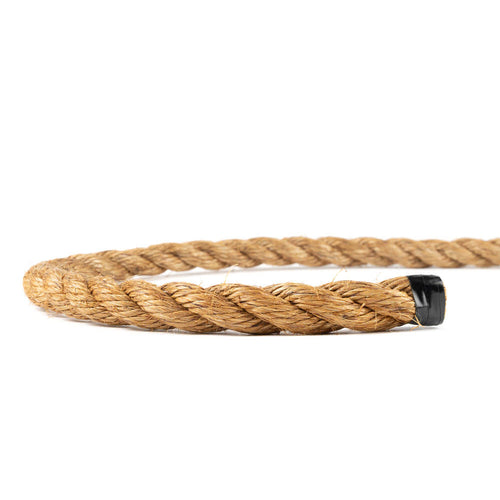
Twisted jute rope Ø 4 mm in warm golden brown on a wooden surface

Jute is harvested from the stems of the jute plant (Corchorus), grown mainly in Bangladesh and India. The fibres are spun into yarn and then processed into twisted or braided rope. Prorope tests every type in its own lab so we can guarantee reliable strength figures.

Twisted vs. braided

Twisted jute rope consists of three strands laid around each other. This gives the rope its classic, coarse appearance and delivers a higher breaking strength at the same diameter: our test lab measured an average of 103 kg for twisted Ø 4 mm, while braided Ø 4 mm averaged 43 kg. Braided jute is more flexible and sheds fewer fibres, which makes it better suited to finer decorative work.

Moisture behaviour & outdoor use

Jute absorbs moisture and can rot or develop mould after prolonged exposure to rain. For permanent outdoor use we recommend protecting the jute rope or replacing it periodically. For short exposure — such as tying up plants in the garden — jute is an excellent choice, and the rope simply breaks down at the end of the season.

Strength loss from knots

As with all fibre ropes, tying a knot causes a loss of strength. For jute rope this loss is typically 40–50% of the measured straight breaking strength. For loaded applications, always account for this knot loss and a generous safety factor when calculating the working load.

Applications

What is jute rope used for?

Gardening & vegetable garden

Jute rope is ideal in the garden: it ties plants gently, breaks down by itself at the end of the season and does not need to be removed.

Tying tomato plants to stakesGuiding climbing plants along a trellisSupporting leeks and beansSecuring young trees to posts
Decoration & interiors

The warm, organic look of jute rope fits perfectly in rustic, bohemian and Scandinavian-inspired interiors.

Making macramé wall hangingsWrapping plant potsBraiding a table runner or garlandDecorating candles and vasesWrapping picture frames
Packaging & presentation

Jute rope adds a natural, artisanal touch to packaging and is perfect for gifts, market stalls and product displays.

Tying gift parcelsBundling bouquets and herbsAttaching market price tagsDecorating wine bottles
Crafts & hobby

Jute rope is easy to work with, dye and cut, which makes it a favourite for hobby and craft projects.

Braiding jewellery and braceletsThreading beads and pendantsDecorating candles and lanternsSchool projects and craft assignments
Agriculture & livestock

In the agricultural sector, jute rope is used for light fastening work where biodegradability is an advantage.

Bundling leaves or branchesTemporarily supporting cropsSecuring nets and cover sheets
Theatre, film & events

The authentic look of jute rope makes it a popular choice among set designers for props, stage decor and themed events.

Decorating pirate or maritime themesDressing marquees and standsProps for film or theatre productions

Also consider

Hemp rope as a stronger alternative

Looking for a natural rope with a similar look but higher strength and better weather resistance? Hemp rope offers a longer service life outdoors and higher breaking strengths — while being just as biodegradable as jute.

View hemp rope →

Comparison

Jute rope vs. other natural fibres

Below we compare jute rope with hemp and sisal on the properties that matter most in everyday use.

PropertyJute ropeHemp ropeSisal rope
Breaking strength Ø 4 mm (twisted)≈ 103 kg (measured)not testednot tested
Breaking strength Ø 4 mm (braided)≈ 43 kg (measured)≈ 160 kg (measured)not tested
BiodegradableYesYesYes
UV resistanceModerateGoodGood
Moisture resistanceLowMediumMedium
FlexibilityMediumStifferStiffer
PriceLowMediumMedium
Typical applicationDecoration, garden, craftsGardening, tying, gardenGarden, packaging, crafts

Conclusion: Jute rope is the most affordable choice for light applications and decorative use. Our lab measurements (ISO 2307:2019) show that twisted jute Ø 4 mm averages 103 kg — a respectable figure for this material. For heavier or longer-term outdoor use, hemp rope offers better weather resistance and higher breaking strength.

Available lengths

Choose your preferred length

At Prorope, jute rope is available on the reel or cut to size. Whether you have a small craft project or need larger quantities: we supply exactly the amount you need.

Small reelOn request

Handy for hobby projects, decoration and crafts. Compact and easy to store.

Large reel / spoolOn request

Suitable for garden centres, retailers and intensive use. Better value per metre.

Cut to sizeOn request

Prorope cuts jute rope to the length you need. Contact us for a quotation.

Technical specifications

Jute rope specifications

Material 100% jute (Corchorus fibre)
Construction Twisted (3-strand) and braided
Colour Natural golden brown
Breaking strength twisted Ø 4 mm Average 103 kg (1.01 kN) — own measurement ISO 2307:2019
Breaking strength braided Ø 4 mm Average 43 kg (0.42 kN) — own measurement ISO 2307:2019
Breaking strength braided Ø 6 mm Average 125 kg (1.23 kN) — own measurement ISO 2307:2019
Melting point N/A (plant fibre, burns/decomposes)
Moisture absorption High — not suitable for permanent underwater use
Biodegradable Yes, fully compostable
Test method ISO 2307:2019, multiple tensile tests per type, without knots, bollard fixtures, carried out by Otto Tromm
Moisture resistance

Jute absorbs water and can rot or develop mould after prolonged exposure to moisture. Outdoors, use jute rope for temporary applications only, or protect it from persistent rain. For permanent outdoor use we recommend hemp or sisal rope.

Knot loss & safety factor

Knot loss has not been tested separately for jute; all jute measurements were carried out without knots. A knot reduces the breaking strength of any rope, so apply a generous safety factor for loaded applications. Jute rope is not suitable for supporting human body weight or for life-saving applications.
Order directly

Jute rope available from stock

Prorope ships jute rope quickly and reliably from our warehouse in Beringe, Limburg. A family business with real expertise and personal advice.

Breaking strengths tested in our own lab (ISO 2307:2019)
Available twisted and braided
Personal advice from Otto Tromm and his team
Shipped quickly from stock in Beringe
View the range

Not sure which diameter or construction you need? Get in touch — we are happy to advise you.

Ask for advice

Our team in Beringe will help you make the right choice for your application.
+31-77 208 6139 · info@prorope.com

Frequently asked questions

FAQ about jute rope

Technical director Otto Tromm tested jute rope on our 50 kN tensile bench in accordance with ISO 2307:2019. Twisted jute Ø 4 mm reached an average of 103 kg (1.01 kN), braided jute Ø 4 mm an average of 43 kg (0.42 kN) and braided jute Ø 6 mm an average of 125 kg (1.23 kN). These are our own measurements without knots, carried out using bollard fixtures with multiple tensile tests per type.
Knot loss for jute has not been measured separately: all our jute measurements were carried out without knots (twisted Ø 4 mm averaging 103 kg, 1.01 kN). A knot reduces the breaking strength of any rope, so apply a generous safety factor and never use jute to carry human body weight.
Twisted jute rope consists of three strands laid around each other and has a higher breaking strength at the same diameter (Ø 4 mm: 103 kg twisted vs. 43 kg braided, both our own measurements). Braided jute is more flexible, sheds fewer fibres and is easier to work with for fine decorative applications.
Jute has limited moisture resistance and can rot or develop mould after prolonged exposure to rain. For temporary outdoor applications — such as tying up plants during the growing season — jute is an excellent choice, and its decomposition is even an advantage. For permanent outdoor use we recommend hemp rope or sisal rope.
Yes, jute rope is fully biodegradable and compostable. This makes it particularly suitable for garden applications where you can simply let the rope decompose in the soil or on the compost heap at the end of the season.
Prorope supplies jute rope in several diameters, including Ø 4 mm and Ø 6 mm. View the current range in our webshop or contact us for advice on the right diameter for your application.
Both are natural plant fibres, but hemp is stronger, more moisture-resistant and more resistant to UV radiation. Jute is softer, more flexible and cheaper, which makes it ideal for decoration and light applications. For heavier garden use or long-term outdoor use, hemp rope is the better choice.
Yes, jute rope takes paint and textile dye well thanks to its porous fibre structure. Preferably use natural or water-based products. Let the rope dry completely after dyeing before you use it.
Jute rope is naturally untreated and plant-based, which generally makes it safe around food crops and animals. Always check on purchase that the rope is free from chemical treatments or coatings, and choose untreated natural jute.
Yes, Prorope can supply jute rope cut to the length you need. Contact us via our contact page for a made-to-measure order or a quotation for larger quantities.

Compare /3

Loading...