

Prorope
Cuerda Dyneema T70 Hawkline / Winch Rope 6 mm – 16 mm
Precio normalDesde €1,95Precio unitario-
-
Prorope.com
Prorope Cabo de Extensión para Cabrestante HMPE con Gazas de Acero Inoxidable
Precio normalDesde €73,95Precio unitario-
Prorope
Cuerda de cabrestante Dyneema SK 75 con gancho 6 mm a 16 mm
Precio normalDesde €44,95Precio unitario-


Winch ropes, also called winch lines or synthetic winch cables, made from Prorope HMPE or Dyneema SK75 replace the steel cable on your winch. They weigh about one seventh of a steel cable of the same diameter, float on water and do not rust. We splice every winch rope ourselves, with the safety hook already fitted.
Do you know the pulling force of your winch? Choose your diameter below and you will see right away which winch rope fits.
- ± 1/7
- of the weight of a steel cable of the same diameter
- 6 to 16 mm
- from ATV winch to forestry winch, 10 to 40 metres or longer made to order
- Floats
- no rust, no sharp steel splinters in your hands
- 1 pm
- ordered on a working day before 1 pm (CET), shipped the same day
Which winch rope fits your winch?
Look up the pulling force of your winch (on the type plate or in the manual) and choose the row it falls under. Both winch ropes in a row suit the same winch.
| Diameter | For winches up to | Typical use | Prorope HMPE winch ropebreaking strength after splicing | Dyneema SK75 winch ropebreaking strength after splicing |
|---|---|---|---|---|
| Winch rope 6 mm | 1,650 kg3,600 lbs | ATV and quad, small winches | 3,510 kgChoose HMPE 6 mm | 3,300 kgChoose SK75 6 mm |
| Winch rope 8 mm | 2,700 kg5,900 lbs | Heavy ATV, UTV, trailer and boat winch | 6,120 kgChoose HMPE 8 mm | 5,400 kgChoose SK75 8 mm |
| Winch rope 10 mm | 4,500 kg9,900 lbs | Most 4x4 winches (8,000 to 9,500 lbs) | 9,450 kgChoose HMPE 10 mm | 9,000 kgChoose SK75 10 mm |
| Winch rope 12 mm | 6,000 kg13,200 lbs | Heavy 4x4 winches (12,000 lbs), light tractor winches | 12,150 kgChoose HMPE 12 mm | 12,600 kgChoose SK75 12 mm |
| Winch rope 14 mm | 8,100 kg17,800 lbs | Tractor and forestry winches up to 8 tonnes | 17,100 kgChoose HMPE 14 mm | 16,200 kgChoose SK75 14 mm |
| Winch rope 16 mm | 10,200 kg22,400 lbs | Heavy forestry winches up to 10 tonnes | 20,520 kgChoose HMPE 16 mm | 21,600 kgChoose SK75 16 mm |
Breaking strength is not a working load. Rule of thumb: the breaking strength should be at least 2× the pulling force of your winch, as stated for the first layer on the drum. The column ‘for winches up to’ is based on that. The breaking strength applies to new rope, after splicing the hook. Always follow the manual of your winch. You choose the length (10 to 40 metres) on the product page; heavier or longer than in the table? We make it to order.
Prorope HMPE winch rope
Blue winch rope made from our own Prorope HMPE rope, 12-strand braided and coated. Spliced by us with a safety hook and a protective sleeve at the hook.
View Prorope HMPE winch ropeDyneema SK75 winch rope
Yellow winch rope made from original Dyneema SK75 fibre, 12-strand braided. For those who choose Dyneema deliberately. Also spliced by us, with the same safety hooks and a protective sleeve at the hook.
View Dyneema SK75 winch ropeBoth are a good choice for the same winch force. Which one you take is up to you.
Check this before you order
- Winch rope by the metre has no hookProrope HMPE, Dyneema SK75 and Dyneema T70 by the metre are loose rope, without hook or splice. Handy if you splice yourself. Want a complete line? Choose a winch rope with hook. HMPE by the metre · SK75 by the metre · T70 by the metre
- Extension line: the weakest link countsThe HMPE winch extension line with stainless steel eyes has a breaking strength of 4,900 kg (8 mm), 7,500 kg (10 mm) or 9,700 kg (12 mm). With the 2× rule, the 8 mm suits winches up to approx. 2,400 kg, the 10 mm up to approx. 3,700 kg and the 12 mm up to approx. 4,800 kg.
- A winch rope is for pullingYou pull a vehicle or a log with it; you do not lift with it. For lifting, use certified lifting gear with a stated working load.
- A snatch block puts more load on the anchorWith a snatch block, the block and the anchor point carry about twice the pulling force of your winch. Choose soft shackles, tree straps and the block accordingly.
- Synthetic rope also recoilsA synthetic winch rope recoils less violently than steel when it breaks, but a break is still dangerous: the hook flies with it. Lay a winch blanket (damper) over the rope and stay out of the line of pull.
- Recovering with a jerk?A winch rope hardly stretches and is not made to absorb shocks. For snatch recoveries with a run-up, use a kinetic recovery rope.
Synthetic winch rope or steel cable: which is better?
For most 4x4, ATV and tractor winches, a synthetic winch rope is the better choice: much lighter, safer when it breaks and nicer to handle. Steel has two real advantages: it copes better with heat and with sharp rocks. This is how they compare.
| Property | Synthetic winch rope (HMPE / Dyneema) | Steel cable |
|---|---|---|
| Weight | About 1/7 of steel of the same diameter | Heavy, and that weight sits at the front of your vehicle |
| When it breaks | Recoils less violently, but is still dangerous | Recoils hard; always use a winch blanket |
| Water and rust | Floats and does not rust | Sinks and can rust without maintenance |
| In your hands | Supple, no sharp wires, does not kink | Broken wires prick, the cable can kink |
| Heat from the winch brake | Sensitive: HMPE up to about 70 °C, protective sleeve on the first metres | Not sensitive, conducts the heat away |
| Sharp rocks and edges | More vulnerable; put a sleeve on chafe points | More resistant to rough ground |
| Inspection | Damage is visible on the outside | Broken inner wires are not always visible |
| Fairlead | Smooth (aluminium) hawse fairlead recommended | Roller fairlead |
| Purchase price | Higher, but Prorope HMPE 10 mm × 30 m with hook costs €146.95 | Usually cheaper |
Choose a synthetic winch rope if…
- you want to winch a 4x4, ATV, UTV or tractor more lightly and safely;
- you often pull the rope out by hand, also over longer distances;
- you work near water or in mud: it floats and does not rust;
- your winch is suitable for synthetic rope (see the manual).
Stay with steel if…
- the brake sits inside the drum and you often power out under load for a long time, for example when lowering;
- the rope constantly runs over sharp stones or rocks;
- you are looking for the lowest purchase price;
- the manufacturer of your winch only allows steel cable.
Advice: not sure about your winch? Send us the make and model, and we will check whether synthetic fits and which diameter you need. Switching? Read the steps below first.
From steel cable to synthetic winch rope
Most winches can be switched. Go through these steps before you spool on the new rope.
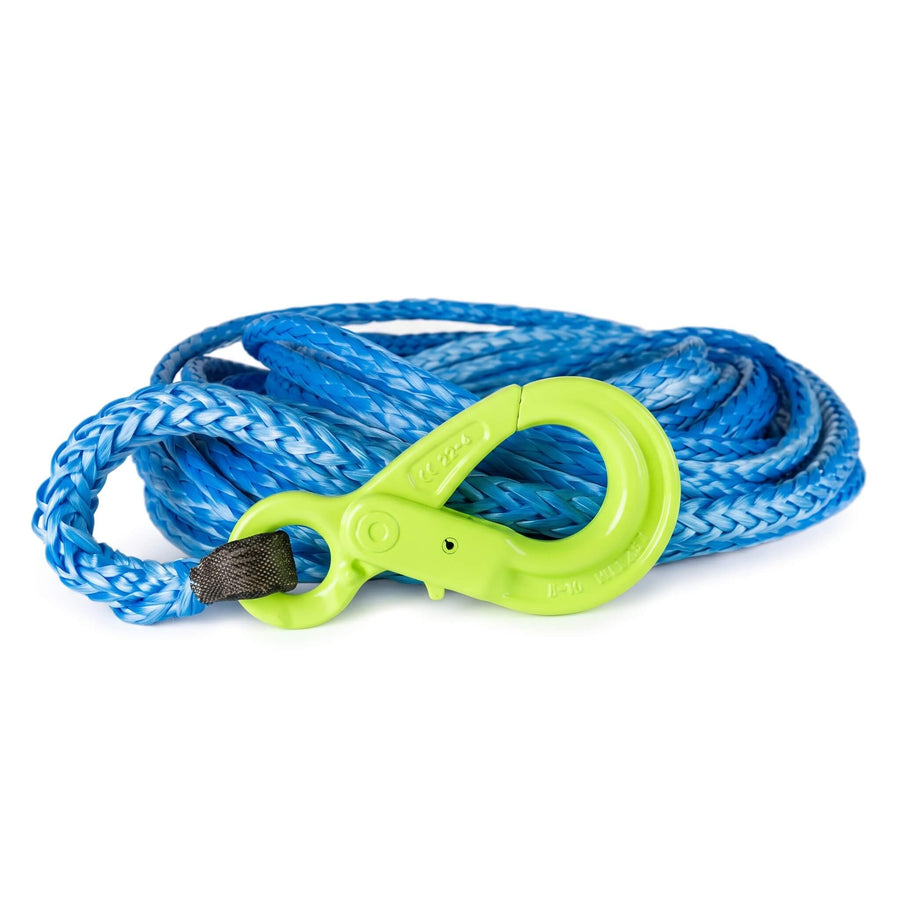
Prorope HMPE winch rope 10 mm with safety hook and protective sleeve.
- Make the drum and fairlead smooth
An old steel cable leaves burrs and sharp edges. Sand them away, otherwise they damage the rope.
- Check your fairlead
For synthetic rope, many winches prescribe a smooth (aluminium) hawse fairlead. If you keep the roller fairlead, make sure the rollers are smooth and turn freely. Follow the manual of your winch.
- Fix the end and spool tightly
Attach the rope as your winch prescribes. Spool the first wraps tightly and neatly next to each other.
- Then spool under tension
Pull the rope out once and spool it back under light load. This keeps the outer layers from cutting in between the lower ones.
- Always leave 10 wraps on the drum
Never unwind the rope completely. The last wraps hold the rope, not the attachment.
- Watch out for heat
HMPE is used up to about 70 °C and melts at around 145 to 150 °C. If the brake sits inside the drum or you pull for a long time, let the winch cool down in between. We make a protective sleeve on the first metres to order.
Winch rope for a tree winch or forestry winch
On a forestry winch you often pull the rope tens of metres into the woods. That is exactly where you notice the low weight of a synthetic winch rope. Forestry winches do need a thicker and longer rope than a 4x4 winch.
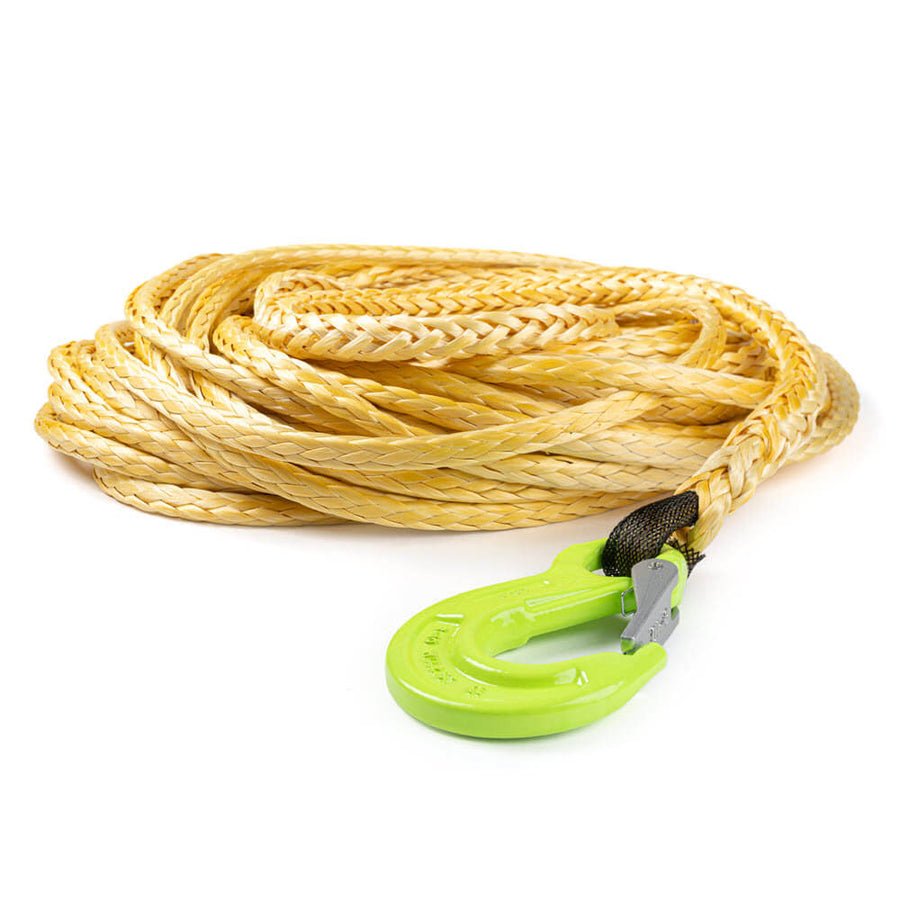
Dyneema SK75 winch rope with safety hook, spliced by us.
- Diameter: choose by the pulling force of your winchA forestry winch of 3 to 10 tonnes usually needs 12, 14 or 16 mm. Find the pulling force on the type plate and choose the row in the table. In doubt between two diameters? Choose the thicker one: a generous safety margin is always better.
- Length: longer than 40 metres is made to orderForestry winches often carry 50 to 100 metres of rope. We make those lengths to order in 1 to 2 working days, for example 14 mm × 60 m and 10 mm × 80 m. See also our custom HMPE winch rope of 199 m.
- Around the trunk: use a tree strapDo not wrap the winch rope around the trunk and do not knot it: that costs a lot of strength and the bark chafes. Put a tree strap around the trunk and connect it with a soft shackle or the hook.
- Heat and chafingIf the brake acts on the drum, let the winch cool down during long pulls. If the rope runs over stones or along trunks, have a protective sleeve fitted on those metres.
Quote for a long winch ropeProrope HMPE by the metre or on a reel
How we make your winch rope
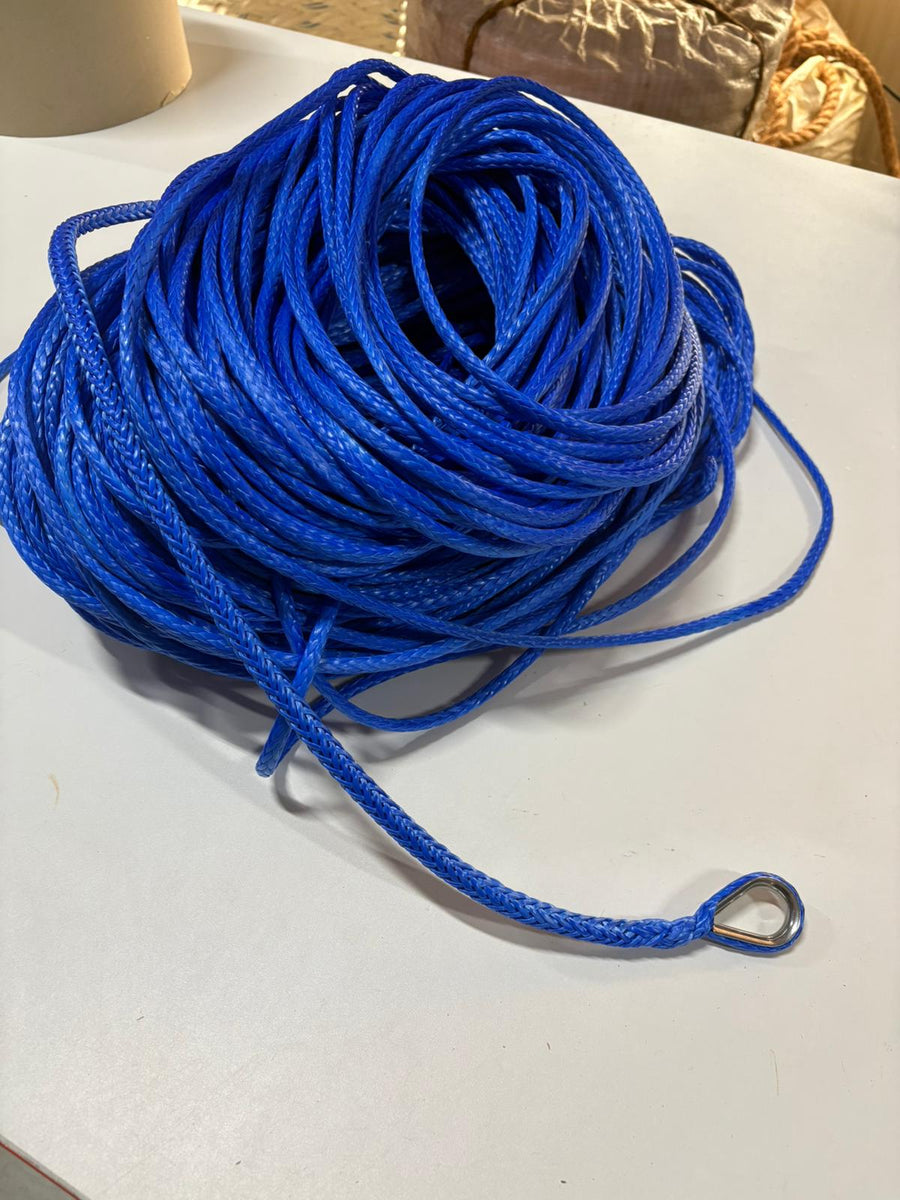
Alexander splices our winch ropes in our own workshop with a Brummel splice and a long bury of 72× the diameter. A good splice costs about 10% strength. That is why the table shows the breaking strength after splicing, not that of loose rope.
A knot costs much more. On our tensile test bench, 5 mm HMPE kept 73% of its strength with a figure-eight knot and 60% with a bowline. So never knot a winch rope to anything.
Otto Tromm tests our rope on our own tensile test bench and we publish every test. Thin rope we can pull to failure: our 4 mm Prorope HMPE reached 1,827 kg. Since May 2026 that rope has also been lying outdoors in an endurance test.
Questions about winch ropes and winch lines
Is a winch line the same as a winch rope or winch cable?
Yes, they are different words for the line on your winch. Winch cable is mostly used for steel; winch rope and winch line mostly for synthetic rope. We sell synthetic winch ropes made from Prorope HMPE and Dyneema SK75, not steel cable.
Which winch rope diameter do I need?
Take a breaking strength of at least 2× the pulling force of your winch. A 9,500 lbs (4,300 kg) 4x4 winch therefore needs at least 8,600 kg: 10 mm. At 12,000 lbs (5,450 kg) it becomes 12 mm. A 3,000 lbs (1,360 kg) ATV winch can use 6 mm. See the table and always follow the manual of your winch.
Is a synthetic winch rope better than a steel cable?
For most winches, yes: it weighs about one seventh, recoils less violently when it breaks, floats and does not rust. Steel copes better with heat from a brake inside the drum and with sharp rocks, and is usually cheaper. See the comparison.
Which rope do you use as a recovery rope for a 4x4?
That depends on how you recover. With a winch, use a winch rope made from HMPE or Dyneema: it hardly stretches. If you pull a stuck vehicle free with a second vehicle and a run-up, use a kinetic recovery rope, which stretches and absorbs the jerk. Connect both with soft shackles.
What is the difference between the Prorope HMPE and the Dyneema SK75 winch rope?
Both are 12-strand braided HMPE, spliced by us with the same safety hooks and a protective sleeve at the hook. The Prorope HMPE is blue and made from our own HMPE rope. The SK75 is yellow and made from original Dyneema SK75 fibre. In every diameter they suit the same winch force; which one you choose is up to you.
Why does the hook say 1.4, 2.5 or 4 t?
That is the working load of the hook for lifting, with a safety factor of 6. The breaking strength of the hook is therefore well above that of the rope. The 6 mm comes with the small hook (1.4 t), 8 and 10 mm with the medium one (2.5 t) and 12 to 16 mm with the large one (4.0 t). A winch rope is still a pulling device, not lifting gear.
How many metres of winch rope fit on my drum?
Look at what is on it now: a synthetic winch rope of the same diameter and length as your steel cable fits about as well. If you choose a thicker rope, less length fits. The drum capacity is in the manual of your winch. Always leave at least 10 wraps on the drum. Too short? Combine it with a winch extension line.
When should I replace my winch rope?
Replace it if strands are cut, if you see melted or glazed spots, if there are hard or flat sections that do not spring back, or if the rope has become noticeably thinner through wear. In doubt? Replace it.
Custom winch rope or unsure about your winch?
A different length, for example 60 or 80 metres, a protective sleeve on the first metres, or advice for your winch? Email info@prorope.com or call +31 77 208 6139. We make custom work in 1 to 2 working days; it cannot be returned.
In stock and ordered on a working day before 1 pm (CET)? Then we ship your winch rope the same day.