


Dyneema Rope SK75 - 6 mm up to 16 mm | Original Dyneema
Price per meter – always in one piece
The quantity you add to your cart = the number of meters.
Dyneema Rope SK75 - 6 mm up to 16 mm | Original Dyneema - 6 mm / Per meter / Gold is backordered and will ship as soon as it is back in stock.
Care information
Care information
Display general product information or specific product information using metafields.
Delivery and Shipping
Delivery and Shipping
Add some general information about your delivery and shipping policies.

Dyneema Rope SK75 - 6 mm up to 16 mm | Original Dyneema

Description
Description
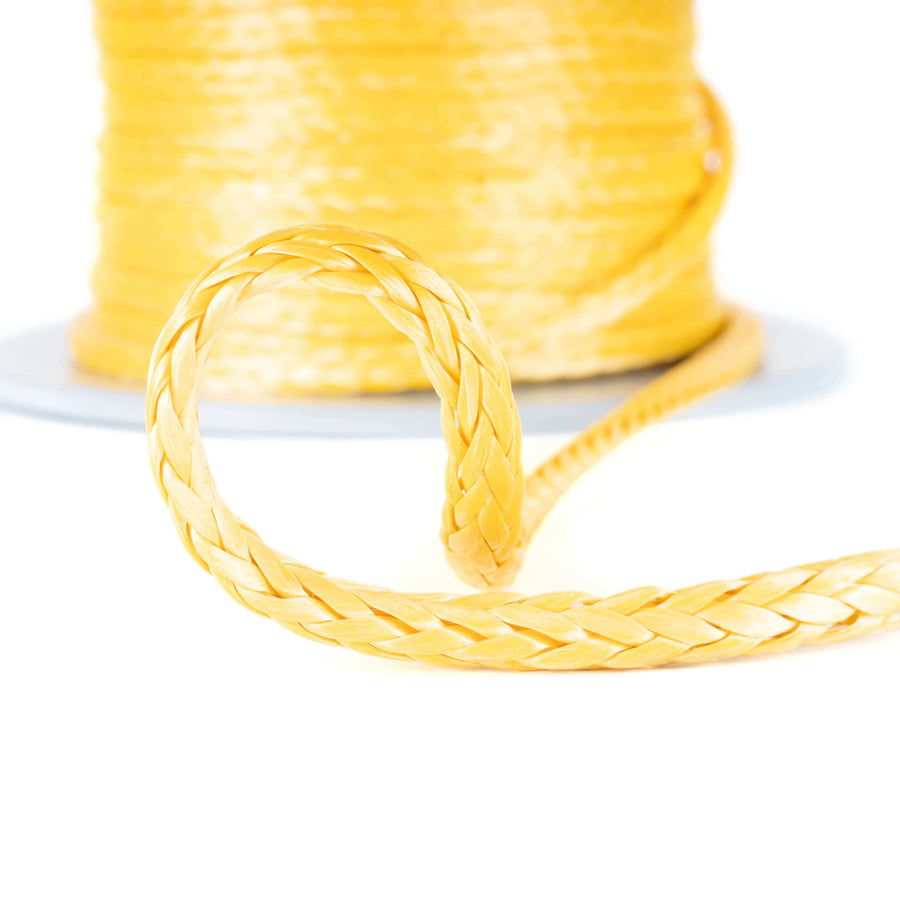
Dyneema rope SK75 is braided from original Dyneema fibre and is, at equal diameter, stronger and many times lighter than steel wire rope. A 10 mm Dyneema rope holds 10,400 kg, floats on water, does not rust and can be handled by hand — exactly why it is replacing steel wire rope in more and more applications.
What is Dyneema rope used for?
Winch rope – the most commonly chosen replacement for steel wire rope on the winch: no barbs, no kinking, and in case of failure no recoil with the energy of steel.
Manure scraper rope – in the barn, where weight, corrosion resistance and safety around animals and people are decisive.
In addition: lifting and lashing, anchor lines, tree care, off-road recovery and anywhere steel wire rope is too heavy or too dangerous.
Breaking strength per diameter
Diameter Breaking strength
6 mm 3,700 kg
8 mm 6,000 kg
10 mm 10,400 kg
12 mm 14,000 kg
14 mm 18,000 kg
16 mm 24,000 kg
Please note: if a hook is spliced into the rope, the breaking strength drops by approximately 10%.
Stronger after breaking in
Dyneema rope is braided from twelve strands, which during braiding do not all end up lying exactly equally tight. By spooling up the rope a number of times under increasing, light tension, the strands settle evenly and take up the load together. A rope that has been properly bedded in is therefore stronger and more reliable than a rope that is fully loaded straight away.
What to watch out for
Dyneema is not steel and requires a different approach:
Heat. The fibre softens from 125–130 °C and melts at around 165 °C. Friction heat is therefore the biggest enemy: make sure the rope does not chafe against anything under load.
Bend radius. Always maintain at least 10× the rope's own diameter. Sharper bends cause internal breakage that you cannot see from the outside.
Payment & Security
Payment methods
Your payment information is processed securely. We do not store credit card details nor have access to your credit card information.
Why choose Dyneema SK75 rope?
Original Dyneema fibre, 12-strand braided with a golden-yellow coating. The rope that replaces steel wire wherever weight, rust and recoil get in the way. By the metre from €2.35.
What will you use the Dyneema SK75 rope for?
Choose your application. See why Dyneema works there, which diameter fits and when another product is the smarter choice.
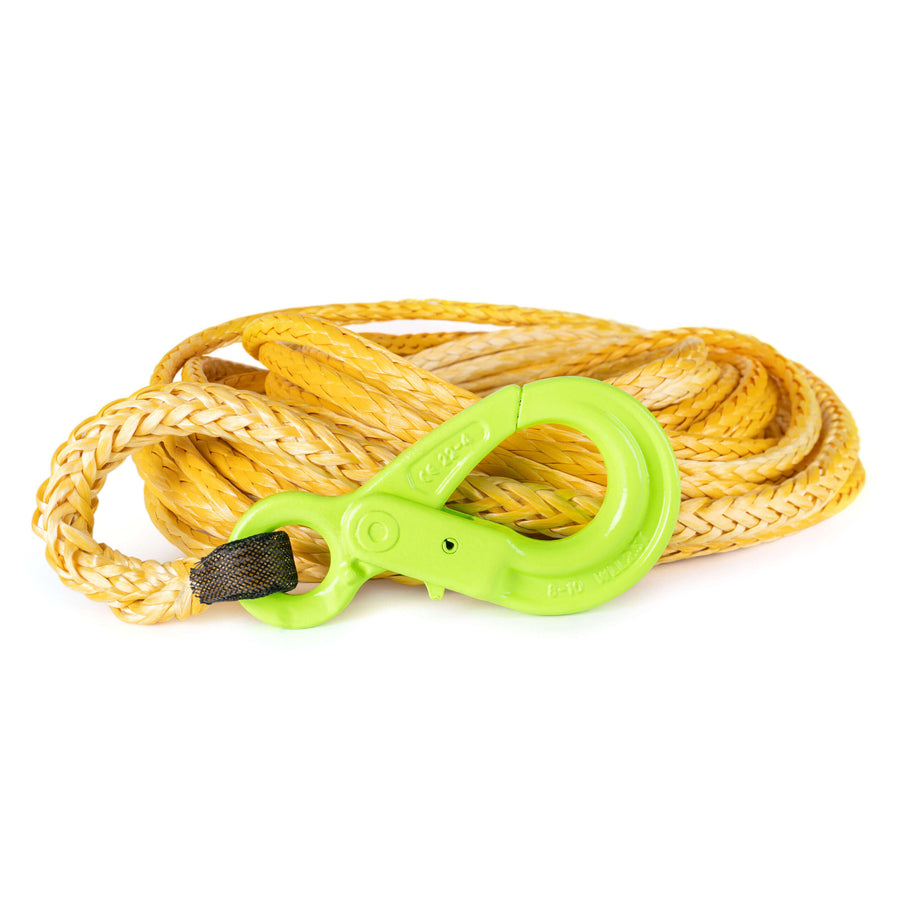
Dyneema SK75 as winch rope
The most popular replacement for steel cable on a winch. No barbs to cut your hands, no kinks, and if it breaks it does not recoil with the energy of steel.
- Safe to handle by hand, even without gloves
- Low stretch: no stored tension that snaps back when unloaded
- Floats, so it works for recoveries through water and mud
Our advice: choose a breaking strength of at least 2× your winch’s pulling capacity. For most 4x4 winches that means 10 mm. Want to fit it straight away? Take the ready-made winch rope with hook, from €44.95.
Switching from steel? Replace a rough fairlead or drum with one free of burrs, ideally an aluminium hawse fairlead, and spool the first layers on under tension.
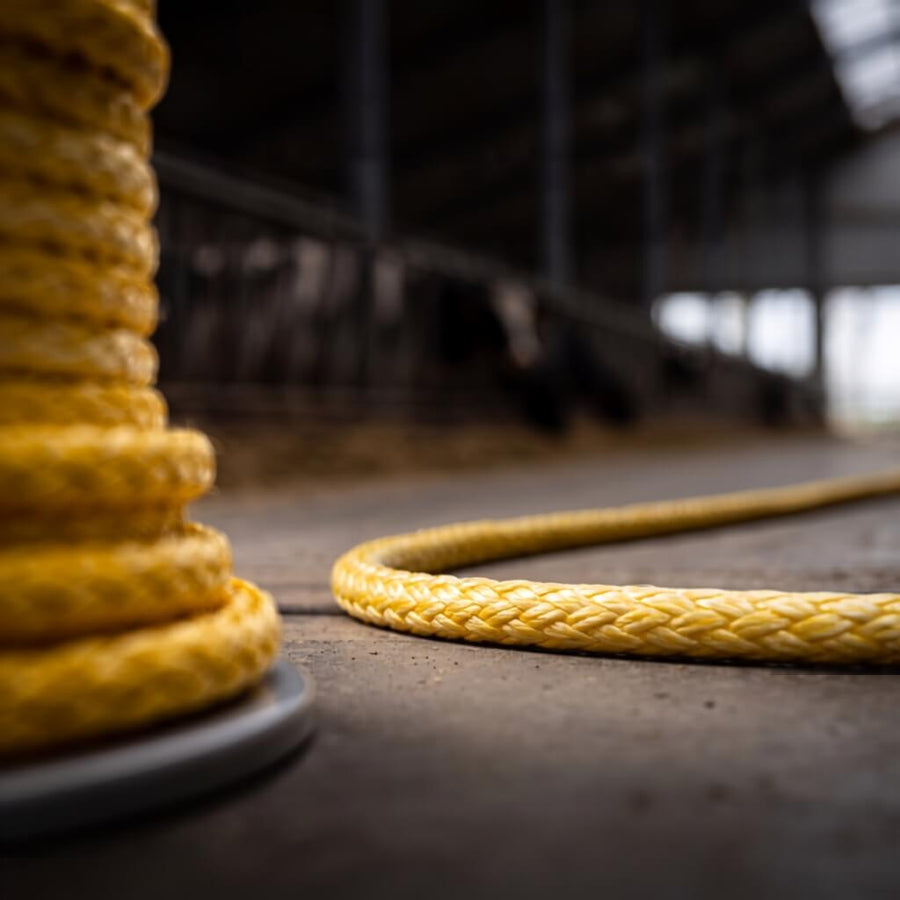
Dyneema SK75 as manure scraper rope
As soon as the PVC sheath of a steel cable tears, the steel keeps rusting out of sight until it breaks. Dyneema does not rust, absorbs virtually no moisture and withstands manure, ammonia and frost.
- No protruding wire ends to injure legs, teats or tails
- Approx. 6 kg per 100 metres: one person can fit the reel
- Hardly any stretch, so the scraper responds immediately
- Does not go stiff in frost, just when your scraper works hardest
Our advice: 10 mm is the standard for most rope scrapers, for alleys up to about 100 to 200 metres. Very long alleys or heavy straw manure? Choose 12 mm. Your scraper manufacturer’s instructions always come first.
On a reel you pay a lot less per metre: 10 mm on a 200-metre reel works out at €5.00 per metre. Reels are available as our Dyneema SK75 manure scraper rope. Want the lowest price and original Dyneema fibre is not a must? Prorope HMPE 10 mm costs €3.50 per metre.
More about manure scraper ropeProrope HMPE manure scraper rope
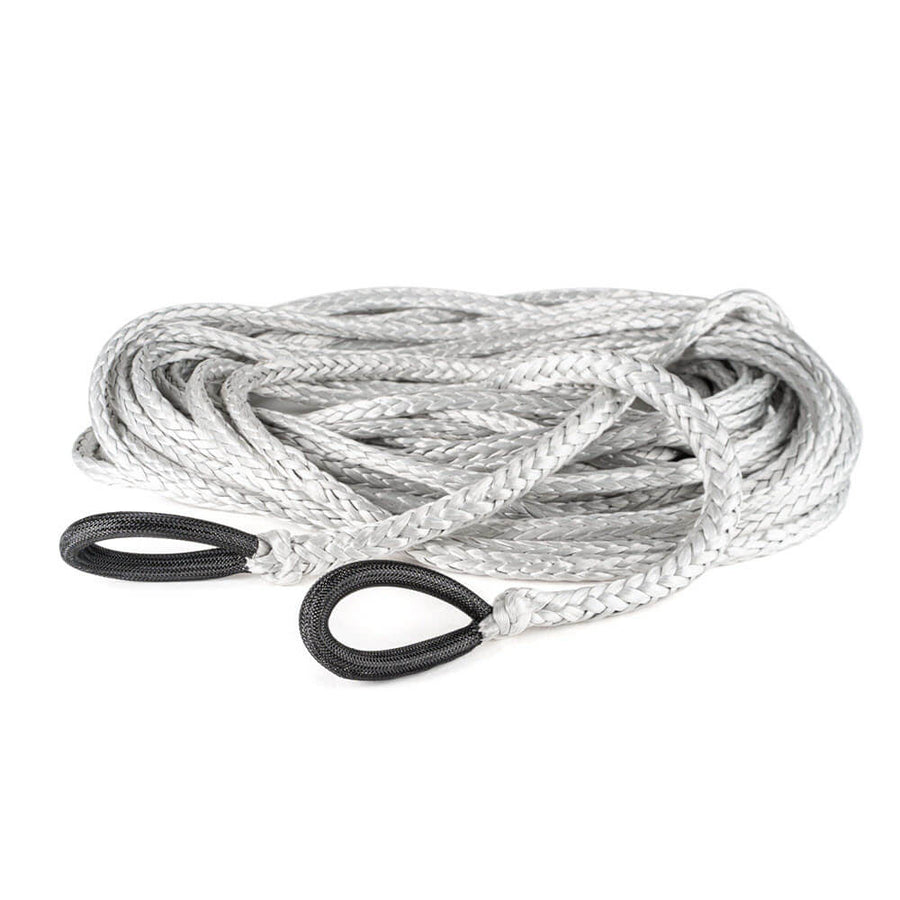
Dyneema for off-road recovery and winch extensions
Anchor point just out of reach? A Dyneema extension line increases your reach without adding weight to your vehicle. Want to splice it yourself? Order the rope by the metre here.
- Light enough to always carry with you
- No kinks and no broken wires, even after a tough recovery
- Floats, so you won’t lose it in the water
Our advice: use the same diameter as your winch rope, or one size up. Splicing takes practice; a ready-made line with spliced eyes is the quickest option for most drivers.
When winching, lay a winch damper over the rope and keep clear while it is under tension. Dyneema can also recoil if it breaks, although far less violently than steel.
HMPE winch extension line with stainless steel eyes, from €73.95
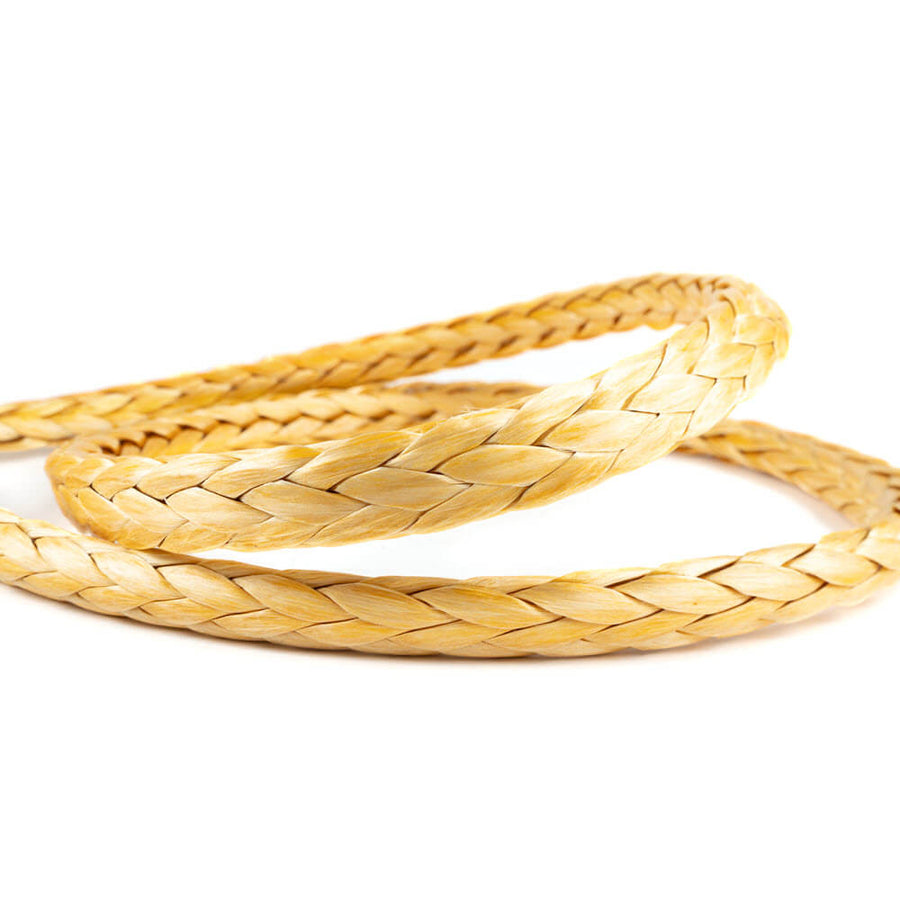
Dyneema SK75 for lifting, lashing and tree care
Thanks to the low stretch, the load hardly shifts once tensioned, and when you pull a tree over, every metre you haul in counts straight away. Long lengths are easy to carry into the woods.
- Up to 24,000 kg breaking strength at 16 mm
- No rust, no maintenance, no greasing
- Can be made to length with spliced eyes
Our advice: 12 to 16 mm, depending on the pulling force of your winch or tractor. Breaking strength is not a working load: allow a generous safety factor. For lifting, use certified lifting gear in line with the applicable regulations.
Dyneema is a pulling rope. For lowering trunk sections with heavy shock loads, choose a rope with more stretch. Need more than 24 tonnes? Take a look at our towing ropes.
Dyneema SK75 on board and on the water
On the water every kilo counts. Dyneema floats, absorbs virtually no water and is resistant to salt water. On deck you work faster with a line that is light and does not rust.
- Floats: a line that goes overboard does not sink
- Resistant to salt water, with UV protection from the golden-yellow coating
- Ideal for tow lines, tension lines and winches on board
Our advice: 6 to 10 mm for most uses on board. For mooring lines, Dyneema is actually not the best choice: a mooring line needs to stretch to absorb shocks from waves and wind.
Does your anchor line need to sink? Dyneema floats, so combine it with a length of anchor chain. Looking for a sheet with grip in the hand? Choose the Liros XTR Racer: a Dyneema SK78 core with an aramid/polyester sheath, from €9.95 per metre.
Which diameter of Dyneema SK75 rope suits you?
Choose a diameter. You will see the breaking strength, the price per metre and what it is suitable for.
Choose your diameter
- Breaking strength
- 10,400 kg
- Price per metre
- €7.00
Winches up to approx. 5,200 kg pulling force (±11,500 lbs), most 4x4 winches, and the standard for rope scrapers.
Better value on a reel 28% cheaper
Reel 100 m €525, 125 m €637.50 or 200 m €999. On 200 metres you pay €5.00 per metre.
View 10 mm on reelsBreaking strength is not a working load. Winch advice based on 2× the pulling force; always follow your winch manufacturer’s instructions. A spliced-in hook reduces the breaking strength by approx. 10%.
Dyneema SK75, T70 or Prorope HMPE rope?
All three are made from UHMWPE fibre: strong, light and rustproof. The difference lies in the fibre, the abrasion resistance and the price.
| Rope | Breaking strength 10 mm | Price 10 mm | Version | Best for |
|---|---|---|---|---|
| Dyneema SK75 ropeThis page | 10,400 kg | €7.00/m 200 m reel €999 |
Original Dyneema, golden-yellow coating more abrasion-resistant than T70 |
Intensive winching, manure scrapers, work over rough edges |
| Dyneema T70 Hawkline | 10,000 kg | €5.45/m | Original Dyneema, grey slightly less abrasion-resistant |
Standard winching at a lower price |
| Prorope HMPE | 10,500 kg | €3.50/m 200 m reel €630 |
HMPE fibre, blue with PU coating | Long lengths at a sharp price |
Breaking strengths as stated on the product pages. Rope we have tested ourselves is in our rope test database.
Ready-made with hook
We supply the Dyneema SK75 winch rope with hook in 6 to 16 mm and 10 to 40 metres, ready to fit on your winch.
Spliced to order
Eyes, lengths or a special version? We splice the rope for you, with a lead time of 1 to 2 weeks.
Bulk orders
Contractor, livestock farmer or business? We will quote for fixed lengths and larger quantities.
Get the most out of your Dyneema SK75 rope
The fibre softens from 125 to 130 °C and melts at around 165 °C. Make sure the rope does not rub against anything under load.
At least 10× the rope’s own diameter. Sharper bends cause internal breakage you cannot see from the outside.
Spool it up a few times under light, increasing tension. The strands settle and take up the load together.
Dyneema is slippery: knots can slip and cost a lot of strength. A splice costs about 10%.
Burrs and sharp edges on the drum, fairlead or pulley damage the rope. Ideally use a hawse fairlead.
Dyneema can also recoil if it breaks. A winch damper over the rope reduces that.
Frequently asked questions
Which diameter do I need for my winch?
Rule of thumb: the breaking strength should be at least 2× your winch’s pulling capacity. That gives 8 mm up to approx. 3,000 kg (±6,600 lbs), 10 mm up to approx. 5,200 kg (±11,500 lbs) and 12 mm up to approx. 7,000 kg (±15,400 lbs). Always follow your winch manufacturer’s instructions too.
What is the difference between SK75, T70 and Prorope HMPE?
SK75 and T70 are both made from original Dyneema fibre with virtually the same breaking strength; SK75 is more abrasion-resistant, T70 is cheaper. Prorope HMPE is made from HMPE fibre and is the best-value choice for long lengths.
Is Dyneema rope safer than steel cable?
Dyneema has no sharp wires, is many times lighter and recoils far less violently than steel cable if it breaks. Always keep clear when it is under tension, though, and use a winch damper when winching.
Can I tie a knot in it?
You can, but Dyneema is slippery: knots can slip and cost a lot of breaking strength. A splice is stronger and more reliable. Want the rope with eyes or a hook? We splice it to order, with a lead time of 1 to 2 weeks.
How do I order the right length?
The quantity in your cart is the number of metres. By the metre, we supply up to 200 metres in one piece; order 270 metres and you will receive 200 + 70 metres. 10 and 12 mm are also available on reels of 100, 125 or 200 metres as our Dyneema SK75 manure scraper rope: one continuous length and much better value per metre.
Found your diameter?
Order by the metre from €2.35 and receive your rope in one piece, cut to length.
